Stroke
Stroke
What are Stroke?
Stroke occurs when the supply of blood to the brain is either interrupted or reduced. When this happens, the brain does not get enough oxygen or nutrients, which causes brain cells to die.
There are three main kinds of stroke; ischemic, hemorrhagic, and TIA. This article will focus on ischemic and hemorrhagic strokes, as there is a separate Knowledge Center article for TIAs, which goes into specific detail about them.
In the U.S., approximately 40 percent of stroke deaths are in males, with 60 percent in females. According to the American Heart Association (AHA), compared with white people, black people have nearly twice the risk of a first-ever stroke and a much higher death rate from stroke.
In 2009, stroke was listed as the underlying cause of death in 128,842 persons in the U.S., resulting in an age-adjusted rate of 38.9 deaths per 100,000 population. The rate was almost twice as high among non-Hispanic blacks (73.6 per 100,000), and the rate of premature death from stroke was also higher among non-Hispanic blacks than their white counterparts (25.0 versus 10.2).
Stroke is more likely to affect people if they are overweight, aged 55 or older, have a personal or family history of stroke, do not exercise much, drink heavily, smoke, or use illicit drugs.
What are the symptoms of Stroke?
Strokes occur quickly, so symptoms often appear suddenly and without warning.
The main symptoms of stroke are:
- Confusion - including trouble with speaking and understanding.
- Headache - possibly with altered consciousness or vomiting.
- Numbness or inability to move parts of the face, arm, or leg - particularly on one side of the body.
- Trouble seeing - in one or both eyes.
- Trouble walking - including dizziness and lack of co-ordination.
- bladder or bowel control problems
- depression
- pain in the hands and feet that gets worse with movement and temperature changes
- paralysis or weakness on one or both sides of the body
- trouble controlling or expressing emotions
- Symptoms vary among patients and may range in severity.
- Face drooping - if the person tries to smile does one side of the face droop?
- Arm weakness - if the person tries to raise both their arms does one arm drift downward?
- Speech difficulty - if the person tries to repeat a simple phrase is their speech slurred or strange?
- Time to call 911 - if any of these signs are observed, contact the emergency services.
Strokes can lead to long-term problems. Depending on how quickly it is diagnosed and treated, the patient can experience temporary or permanent disabilities in the aftermath of a stroke. In addition to the persistence of the problems listed above, patients may also experience the following:
The acronym F.A.S.T. is a way to remember the signs of stroke, and can help identify the onset of stroke more quickly:
The faster a person with suspected stroke receives medical attention, the better their prognosis and the less likely they will be to experience lasting damage or death.
What are the causes of Stroke?
Causes of ischemic stroke
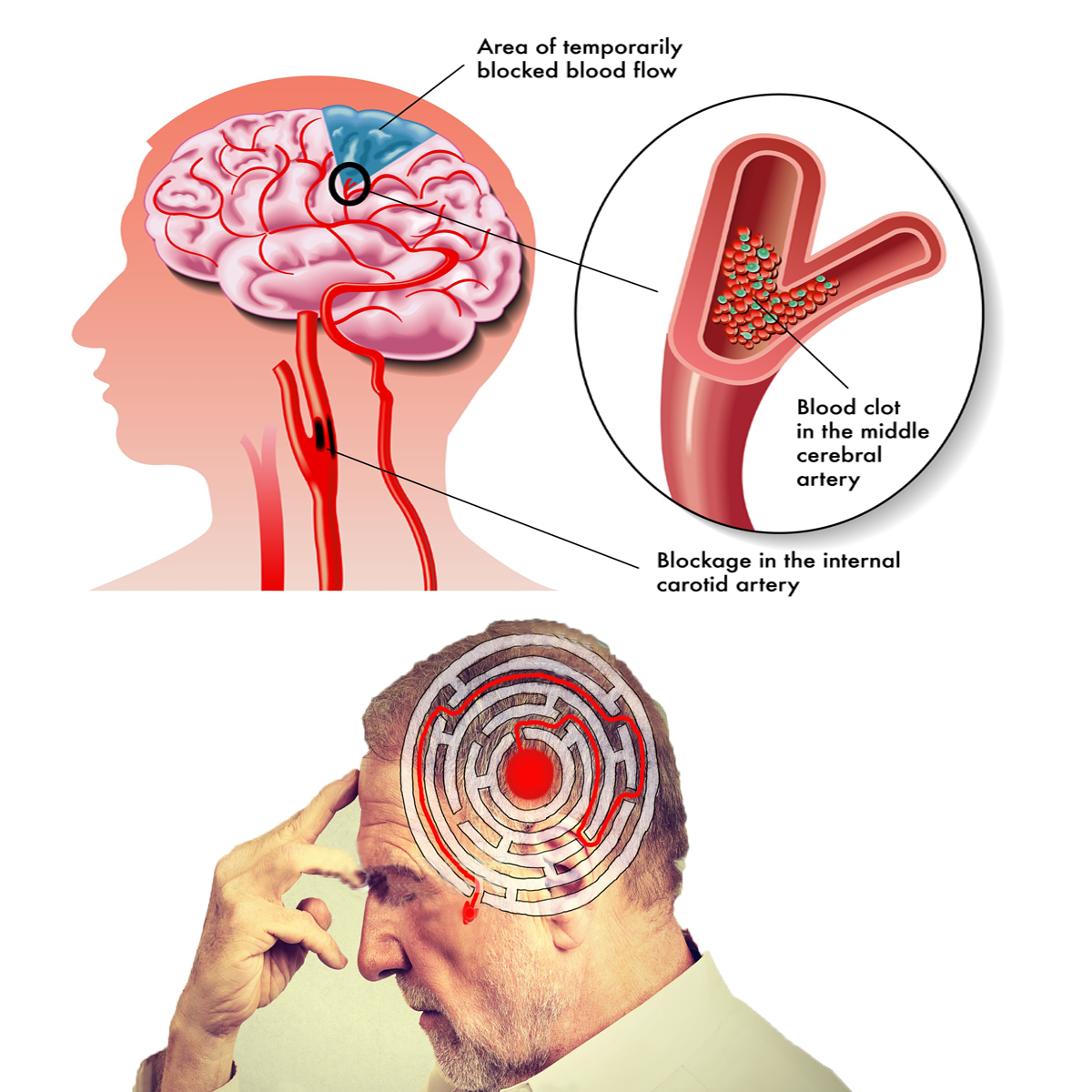
Ischemic stroke is the most common form, accounting for around 85 percent of strokes. This type of stroke is caused by blockages or narrowing of the arteries that provide blood to the brain, resulting in ischemia - severely reduced blood flow that damages brain cells.
These blockages are often caused by blood clots, which can form either in the arteries within the brain, or in other blood vessels in the body before being swept through the bloodstream and into narrower arteries within the brain. Fatty deposits within the arteries called plaque can cause clots that result in ischemia.
Causes of hemorrhagic stroke
Hemorrhagic strokes are caused by arteries in the brain either leaking blood or bursting open. The leaked blood puts pressure on brain cells and damages them. It also reduces the blood supply reaching the brain tissue after the hemorrhage point. Blood vessels can burst and spill blood within the brain or near the surface of the brain, sending blood into the space between the brain and the skull.
The ruptures can be caused by conditions such as hypertension, trauma, blood-thinning medications, and aneurysms (weaknesses in blood vessel walls).
Intracerebral hemorrhage is the most common type of hemorrhagic stroke and occurs when brain tissue is flooded with blood after an artery in the brain bursts. Subarachnoid hemorrhage is the second type of hemorrhagic stroke and is less common. In this type of stroke, bleeding occurs in an artery in the subarachnoid space - the area between the brain and the thin tissues that cover it.
Causes of transient ischemic attack (TIA)
TIAs are different from the kinds above because the flow of blood to the brain is only briefly interrupted. TIAs are similar to ischemic strokes in that they are often caused by blood clots or other clots.
TIAs should be regarded as medical emergencies just like the other kinds of stroke, even if the blockage of the artery and symptoms are temporary. They serve as warning signs for future strokes and indicate that there is a partially blocked artery or clot source in the heart.
According to the Centers for Disease Control and Prevention (CDC), over a third of people who experience a TIA go on to have a major stroke within a year if they have not received any treatment. Between 10-15 percent will have a major stroke within 3 months of a TIA.
How is Stroke treated?
As the ischemic and hemorrhagic strokes are caused by different factors, both require different forms of treatment. It is not only important that the type of stroke is diagnosed quickly to reduce the damage done to the brain, but also because treatment suitable for one kind of stroke can be harmful to someone who has had a different kind.
How is ischemic stroke treated?
Ischemic strokes are caused by arteries being blocked or narrowed, and so treatment focuses on restoring an adequate flow of blood to the brain.
Treatment can begin with drugs to break down clots and prevent others from forming. Aspirin can be given, as can an injection of a tissue plasminogen activator (TPA). TPA is very effective at dissolving clots but needs to be injected within 4.5 hours of stroke symptoms starting.
Emergency procedures include administering TPA directly into an artery in the brain or using a catheter to physically remove the clot. Recent studies have questioned the effectiveness of these methods, and so research is still ongoing as to how beneficial these procedures are.
There are other procedures that can be carried out to decrease the risk of strokes or TIAs. A carotid endarterectomy involves a surgeon opening the carotid artery and removing any plaque that might be blocking it.
Alternatively, an angioplasty involves a surgeon inflating a small balloon in a narrowed artery via catheter and then inserting a stent (a mesh tube) into the opening to prevent the artery from narrowing again.
How is hemorrhagic stroke treated?
Hemorrhagic strokes are caused by bleeding into the brain, so treatment focuses on controlling the bleeding and reducing the pressure on the brain.
Treatment can begin with drugs given to reduce the pressure in the brain, control overall blood pressure, prevent seizures and prevent sudden constrictions of blood vessels. If the patient is taking blood-thinning anti-coagulants or an anti-platelet medication like Warfarin or Clopidogrel, they can be given drugs to counter the medication's effects or blood transfusions to make up for blood loss.
Surgery can be used to repair any problems with blood vessels that have led or could lead to hemorrhagic strokes. Surgeons can place small clamps at the base of aneurysms or fill them with detachable coils to stop blood flow and prevent rupture.
If the hemorrhage was caused by arteriovenous malformations (AVMs), surgery can also be used to remove small them if they are not too big and not too deep within the brain. AVMs are tangled connections between arteries and veins that are weaker and burst more easily than other normal blood vessels.
Disclaimer
This article is for information only and should not be used for the diagnosis or treatment of medical conditions. Doctors Catalog has used all reasonable care in compiling the information but makes no warranty as to its accuracy. Consult a doctor or other health care professional for diagnosis and treatment of medical conditions. In the event of an emergency, please call 108 for immediate assistance.